Tooth replacement
Dental implants in Irving, TX
Replace a missing tooth with one that’s anchored in bone, looks natural and lets you eat what you like. We plan every implant with a 3D scan and go over the cost with you before anything starts.
- 3D CBCT scan for precise planning
- Single teeth to full-arch dentures
- Written estimate and financing options

What a dental implant is, and why people choose one
A dental implant replaces the root of a missing tooth. A small titanium post is placed in the jawbone, the bone bonds to it over a few months, and then a custom crown, bridge or denture attaches on top. For patients getting dental implants in Irving, the result is a tooth that doesn’t slip, doesn’t lean on the teeth next to it, and is cleaned much like a natural one.
For most people the deciding factor is everyday life: biting into an apple again, smiling in photos without thinking about a gap, or finally retiring a denture that moves when they talk. Implants also help preserve the jawbone where a tooth is missing, which bridges and dentures can’t do.
Our dentists are general dentists, and implants are a big part of what we do. Dr. Anh Nguyen has a special interest in dental implants, and Dr. Chloe Kim focuses much of her work on extractions and implants, so the same team can take you from a failing tooth to a finished smile.
Signs you might need dental implants
- You’re missing one or more teeth
- A tooth is cracked, failing or slated for extraction
- Your denture slips when you eat or talk
- You avoid certain foods because chewing is uncomfortable
- An old bridge has failed or the teeth under it are decaying
- You hide a gap when you smile
Are you a candidate for dental implants?
Most adults who are missing teeth can get implants. What matters most is your overall health, the health of your gums, and whether there’s enough bone to hold the post. Age alone is rarely the issue, though teens usually need to wait until the jaw has finished growing.
- Healthy gums, or gum disease that’s treated first with gum disease treatment
- Enough jawbone, or a plan to rebuild it with a bone graft
- Health conditions such as diabetes under reasonable control
- Willingness to keep up with daily cleaning and regular checkups
Some factors call for extra planning rather than a flat no. Smoking slows healing and raises the risk of implant problems. Certain osteoporosis and cancer medications, and past radiation to the head or neck, need a careful review. Because our medical providers work in the same building, we can coordinate with them or your own physician when your health history is complicated, with your permission.
One tooth, several teeth or a full arch
Implants aren’t one product. They’re a foundation, and what goes on top depends on how many teeth you’re replacing.
| Option | A good fit when | Typical implants |
|---|---|---|
| Single implant and crown | One tooth is missing and the neighbors are healthy | 1 |
| Implant-supported bridge | Two to four teeth in a row are missing | Usually 2 |
| Snap-in implant denture | A full denture feels loose, especially on the bottom | Usually 2–4 per arch |
| Fixed full-arch bridge | You want teeth that don’t come out at home | Usually 4 or more per arch |
A single implant leaves the teeth on either side untouched, unlike a traditional dental bridge, which requires shaping those teeth for crowns. For a full arch, even two implants make a lower denture dramatically more stable than one held by suction and adhesive.
Planning with a 3D CBCT scan
Before we recommend an implant, we take a 3D CBCT (cone beam) scan right here in the office. A regular x-ray is flat. A CBCT shows the height, width and density of your bone, plus the exact location of nerves and the sinuses, so we can choose the right implant size and angle and spot the need for a bone graft before surgery day, not during it.
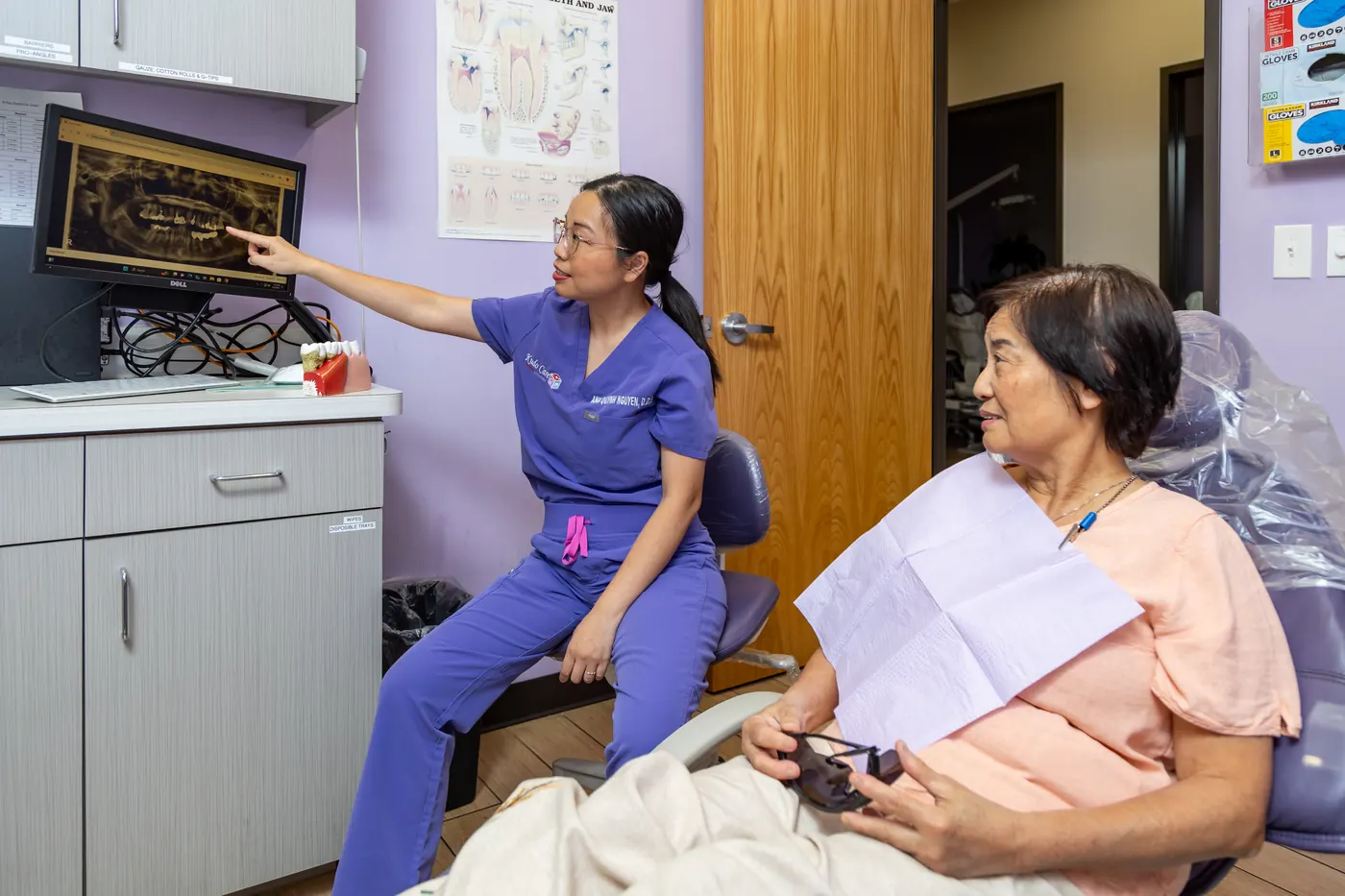
We pair the scan with digital impressions, so there are no trays of goopy material. You’ll see your own images on screen while we explain the plan, and you can take your time deciding.
When you need a bone graft first
After a tooth is lost, the bone that held it starts to shrink, and much of that change happens in the first few months. Long-standing gaps, old infections and advanced gum disease can leave too little bone for an implant. In those cases, a bone graft rebuilds the area.
If we’re removing a tooth that will later be replaced with an implant, we often place a graft in the socket the same day to preserve the bone. Occasionally the implant can go in at the same visit as the extraction; more often the site heals for a few months first. Your scan, not a sales script, decides which route makes sense.
Caring for your implant
Implants can’t get cavities, but the gums and bone around them can become inflamed if plaque builds up. This is called peri-implantitis, and it’s the main reason implants run into trouble years later.
- Brush twice a day, and clean around the implant daily with floss, a water flosser or small interdental brushes
- Keep regular cleanings and exams so we can check the gums and take x-rays when needed
- Wear a night guard if you grind or clench
- Don’t smoke; it’s linked to bone loss around implants
With good care, most implants last for decades. The crown on top takes the daily wear and may need replacing after many years, which is a much smaller job than replacing the implant.
What to expect, step by step
- Consult and 3D scan
We examine your mouth, review your health history and take a 3D CBCT scan. You leave with your options and a written estimate.
- Prepare the site
If needed, we remove a failing tooth, treat gum disease or place a bone graft, then give the area time to heal.
- Place the implant
With the area thoroughly numbed, the post is placed in the bone. Most patients feel pressure, not pain, and are back to normal routines within a day or two.
- Let the bone bond
Over roughly three to six months, the bone fuses to the implant. In many cases you can wear a temporary tooth in the meantime.
- Attach your new tooth
We take digital impressions and attach a custom abutment and crown, bridge or denture, shaded to blend with your smile.
Cost, insurance & financing
Every implant plan is different, so we don’t quote a price until we’ve seen your scan. As a general guide, a single implant with its abutment and crown commonly runs about $3,500–$6,000 in the Dallas–Fort Worth area. Implant-supported dentures range more widely, from several thousand dollars per arch for a snap-in denture on two implants to well over $20,000 per arch for a fixed full-arch bridge.
What changes the price: whether you need an extraction or bone graft, how many implants are involved, the type of crown or denture, and where in the mouth the work is done. You get a written estimate before treatment starts. Many PPO plans help with part of the cost, and financing through Cherry, Affirm or CareCredit (subject to credit approval) can spread payments out. See insurance and financing, or read our guide to dental implant costs in Irving.
Patient reviews
Neighbors who’d send you our way
“Had a great experience coming here first time. Staff was very friendly and professional. Cleaning went great. Fernando was very nice and friendly, best customer service I’ve had from any dental office.”“I’ve been coming to this clinic for several years now. I like that they have different specialties all in one place, offer flexible appointment times, and are open on weekends. Everyone is very friendly.”“I always have a positive experience and I feel like my concerns are taken seriously. This makes me feel reassured and that I’m being listened to. It’s great that they open weekends!”FAQ
Dental Implants: your questions, answered
Still have a question? Call (469) 706-0710 — a real person answers, in English, Spanish or Vietnamese.
How long do dental implants last?
The implant post is designed to be permanent, and studies commonly report that well over 90% of implants are still working after 10 years. The crown on top takes the daily wear, so it may need replacing after many years of use. The biggest factors you control are daily cleaning, regular checkups and not smoking. If you grind your teeth, a night guard helps protect the crown.
Does getting a dental implant hurt?
The area is numbed thoroughly, so most patients feel pressure and vibration rather than pain while the implant is placed. Afterward, expect some soreness and mild swelling for a few days, which over-the-counter pain relievers usually manage. Many people say it was easier than the extraction that came before it. If you’re anxious, ask about our comfort and sedation options.
How long does the whole dental implant process take?
For most people, it’s three to six months of healing after the implant is placed, plus a few weeks for the final crown. If you need an extraction and bone graft first, add a few more months, so the full timeline can run from about four months to a year. In select cases an implant can go in the same day a tooth is removed. Your 3D scan tells us which timeline fits you.
Does dental insurance cover implants?
Some PPO plans cover part of an implant, while others cover only the crown or pay toward an implant as if it were a bridge or denture. Annual maximums also limit how much a plan pays in a year, which is why some patients split treatment across two plan years. We check your benefits and show what your plan is expected to pay on your written estimate before you decide.
Can I get an implant if I have diabetes or I smoke?
Often, yes. Well-controlled diabetes usually isn’t a barrier, though healing can be slower when blood sugar runs high. Smoking raises the risk of implant failure, so we’ll talk honestly about cutting back or quitting around surgery. Because our medical providers are in the same building, we can coordinate with them if you’d like, so your dental and medical care are on the same page.
Is an implant better than a bridge or a denture?
It depends on your bone, your budget and the teeth next to the gap. Implants protect bone and leave neighboring teeth untouched, but they take months and cost more up front. A bridge is faster but relies on the adjacent teeth. Dentures are the most affordable way to replace many teeth at once. We’ll lay out the trade-offs side by side so you can choose with confidence.
Can I schedule dental implant visits on weekends in Irving?
Yes. We’re open Saturdays from 9 a.m. to 6 p.m. and Sundays from 9 a.m. to 1 p.m., in addition to weekdays, so consults, follow-ups and crown appointments can often fit around work. Our office at 3425 Grande Bulevar, across from Irving Mall, has free on-site parking and is an easy drive from Las Colinas, Valley Ranch, Coppell and Grand Prairie.
Keep exploring
Care that often goes with it
Bone Grafting
Preserve or rebuild jawbone after tooth loss or gum disease so an implant has a solid foundation.
Learn moreDental Crowns
Natural-looking crowns to protect cracked, worn or root-canal-treated teeth.
Learn moreDentures
Complete and partial dentures, plus implant-supported options for a more secure fit.
Learn moreTooth Extractions
Gentle simple and surgical extractions, including wisdom teeth, with a plan to replace the tooth.
Learn moreReady when you are — even on Sunday.
Request a time online in about a minute, call us, or simply walk in during open hours. We’ll take it from there.
Open 7 days a week
Walk-ins welcome · Sundays 9–1
- Monday: 9 AM–6 PM
- Tuesday: 9 AM–6 PM
- Wednesday: 10 AM–7 PM
- Thursday: 9 AM–6 PM
- Friday: 9 AM–6 PM
- Saturday: 9 AM–6 PM
- Sunday: 9 AM–1 PM