Gum care
Gum disease treatment in Irving, TX
Bleeding, puffy or receding gums are worth taking seriously. We find out how far gum disease has gone, treat it thoroughly and comfortably, and help you keep it under control.
- Gum measurements and digital x-rays
- Deep cleaning with a quiet piezo scaler
- Medical team in the same building

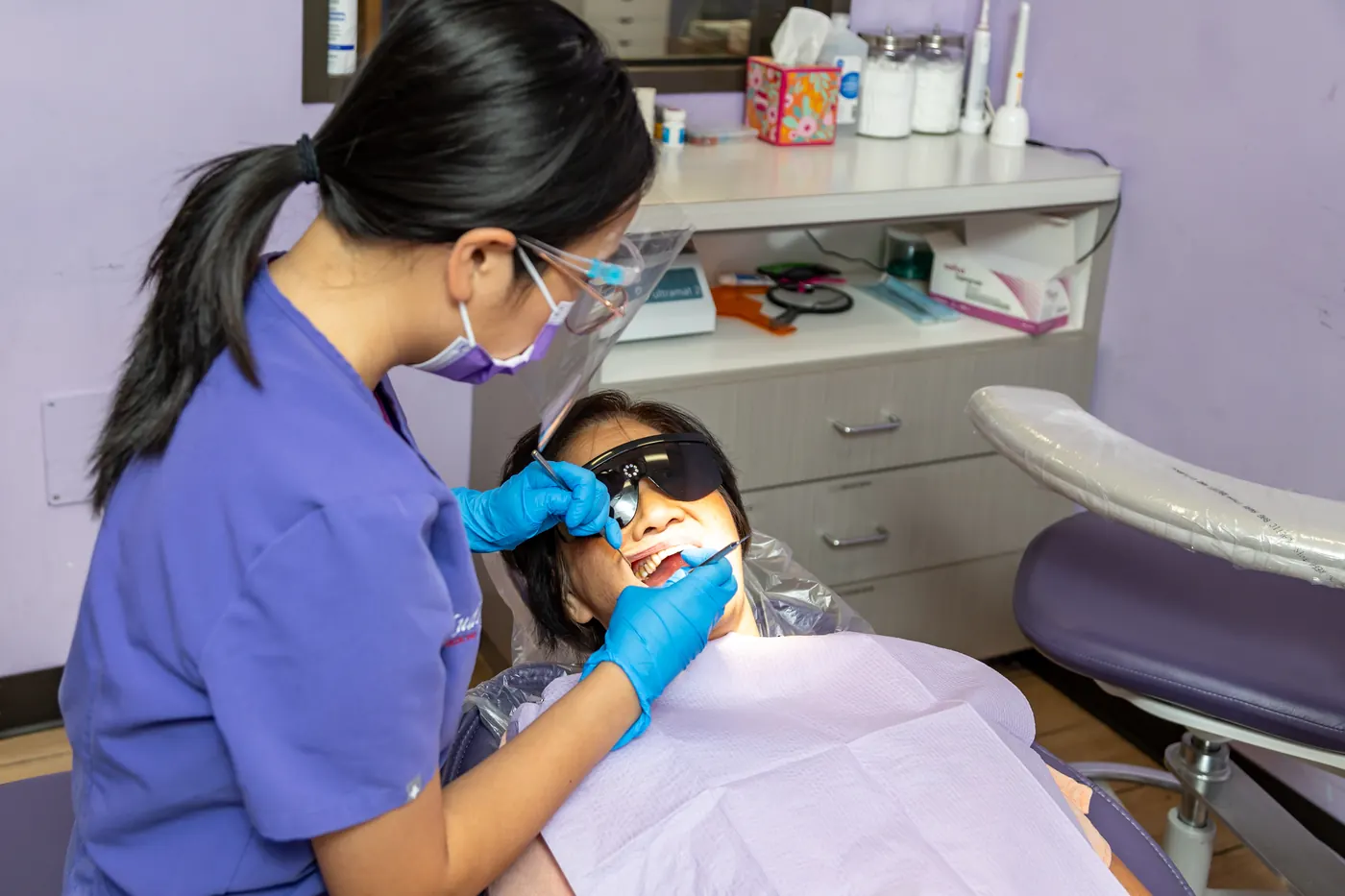
Gum disease treatment in Irving starts with an honest diagnosis
Gum disease is an infection of the tissues that hold your teeth in place. It's very common — CDC research has found that roughly four in ten U.S. adults age 30 and older have periodontitis, the more serious form — and it often doesn't hurt until it's advanced. That's why gum disease treatment at our Irving office starts with careful measurements, not guesses.
During your exam, we gently measure the small space between each tooth and the gum. Healthy pockets are usually 1 to 3 millimeters deep. Deeper pockets, bleeding and bone loss on digital x-rays tell us how far the disease has gone and which treatment makes sense.
Signs you might need gum disease treatment
- Gums bleed when you brush or floss
- Red, puffy or tender gums
- Bad breath or a bad taste that won't go away
- Gums pulling back so teeth look longer
- Loose teeth or a change in your bite
- Pus between your teeth and gums
Gingivitis vs. periodontitis
| At a glance | Gingivitis | Periodontitis |
|---|---|---|
| What's happening | Plaque bacteria inflame the gum line | Infection spreads below the gums and destroys bone and the fibers holding teeth |
| Common signs | Red, puffy gums that bleed when you brush or floss | Bleeding plus receding gums, bad breath, deep pockets, loose or shifting teeth |
| Does it hurt? | Usually not | Often not until late |
| Reversible? | Yes, with cleanings and better home care | Lost bone doesn't return, but the disease can be stopped and controlled |
| Typical treatment | Professional cleaning and better brushing and flossing | Scaling and root planing, then maintenance every 3–4 months |
Gingivitis is a warning sign. Treated early, the gums return to health. Left alone, it can progress to periodontitis, a major cause of tooth loss in adults.
Scaling and root planing (deep cleaning), explained
A regular cleaning removes plaque and tartar above the gum line. A deep cleaning goes further, reaching down into the pockets to clear out hardened tartar and bacteria a toothbrush can't touch. It has two parts: scaling removes the buildup, and root planing smooths the root surfaces so the gums can tighten back around the teeth and pockets can shrink.
We usually treat one side of the mouth at a time, over two visits, so you're never numb on both sides at once. We numb thoroughly, and most patients feel pressure and vibration, not pain. Our chairs have a built-in piezo scaler designed to be quieter and smoother. If dental visits make you anxious, ask about our sedation options; we'll review which are appropriate for your health history.
Afterward, gums may be tender and teeth a bit sensitive to cold for a few days. Warm salt-water rinses, soft foods and an over-the-counter pain reliever usually take care of it. Light bleeding when you brush in the first few days is normal.
Gingivectomy and other gum procedures
Sometimes the gum tissue itself is the problem. A gingivectomy removes excess or diseased gum tissue to reduce deep pockets that cleaning alone can't fix, or to trim gums that have overgrown. Overgrowth can happen with certain medications, including some seizure, blood pressure and anti-rejection drugs. The area is numbed first, and healing usually takes a week or two.
Where gum disease has destroyed bone, bone grafting may help support a tooth or prepare the area for an implant later. For very advanced cases, we'll be straightforward about your options, including referral to a periodontist when that's the best path.
Maintenance cleanings: keeping it under control
Periodontitis is managed, not cured. After a deep cleaning, bacteria start to recolonize the pockets within a few months, so most patients need periodontal maintenance cleanings every three to four months instead of twice a year. These visits clean deeper than a routine cleaning and let us re-measure your pockets to catch changes early.
Home care is the other half. Our hygienist, My Phuong Tran, R.D.H., believes oral health is a life skill everyone deserves to understand, and she'll show you — calmly and clearly — the techniques that work for your mouth: angling your brush toward the gum line, using floss or small interdental brushes, and whether a water flosser makes sense. If you smoke, quitting is one of the best things you can do for your gums.
Gum health, diabetes and your heart
Your gums don't exist in isolation. People with diabetes are more likely to develop gum disease, and serious gum infection can make blood sugar harder to control. Researchers have also found links between gum disease and heart disease, though they haven't shown that one causes the other. Pregnancy hormones can make gums more likely to swell and bleed, too.
Kudo Care Center's primary care team — including Dr. AJ Nguyen, MD, and Dr. Ryan Kim, MD — is in the same building, so if you'd like your dentist and doctor to coordinate, they're just down the hall. Read more in our guide to gum disease and diabetes.
What to expect, step by step
- Measure and image
We measure pocket depths around every tooth and take digital x-rays to check bone levels.
- Numb one side
We numb the area thoroughly — usually one side of the mouth per visit — and make sure you're comfortable.
- Scaling
Using a piezo scaler and fine hand instruments, we remove tartar and bacteria from above and below the gum line.
- Root planing
We smooth the root surfaces so bacteria have fewer places to cling and the gums can tighten around the teeth.
- Re-check in 4–6 weeks
We re-measure the pockets to see how your gums have healed and decide on next steps.
- Maintenance every 3–4 months
Periodontal maintenance cleanings keep bacteria in check and catch changes early.
Cost, insurance & financing
In the Dallas–Fort Worth area, scaling and root planing typically costs about $150 to $400 per quadrant (one-quarter of the mouth), so a full-mouth deep cleaning often runs roughly $600 to $1,600 without insurance. Periodontal maintenance visits usually cost somewhat more than a regular cleaning. Many PPO plans cover part of a deep cleaning, and Texas Medicaid and CHIP cover dental care for children 18 and under.
Your exact cost depends on how many areas need treatment, how deep the pockets are and whether you need a gingivectomy or bone grafting. We give you a written estimate before treatment. If you're uninsured, financing and our Concierge Membership are options — see insurance and financing.
Patient reviews
Neighbors who’d send you our way
“Had a great experience coming here first time. Staff was very friendly and professional. Cleaning went great. Fernando was very nice and friendly, best customer service I’ve had from any dental office.”“I’ve been coming to this clinic for several years now. I like that they have different specialties all in one place, offer flexible appointment times, and are open on weekends. Everyone is very friendly.”“I always have a positive experience and I feel like my concerns are taken seriously. This makes me feel reassured and that I’m being listened to. It’s great that they open weekends!”FAQ
Gum Disease Treatment: your questions, answered
Still have a question? Call (469) 706-0710 — a real person answers, in English, Spanish or Vietnamese.
Can gum disease be cured?
Gingivitis, the early stage, can be fully reversed with a professional cleaning and good daily brushing and flossing. Periodontitis can't be cured in the sense of growing lost bone back, but it can be stopped and kept under control. With a deep cleaning, maintenance visits every three to four months and steady home care, many people keep their teeth for life.
Does a deep cleaning hurt?
We numb the area thoroughly first, so most patients feel pressure and vibration rather than pain. Your gums may be tender for a few days afterward, and teeth can be sensitive to cold for a week or two as the gums heal. Warm salt-water rinses and an over-the-counter pain reliever usually handle it.
How long does a deep cleaning take?
Most deep cleanings are split into two visits, each covering one side of the mouth and lasting about an hour to an hour and a half. Splitting it up keeps you comfortable and means you're only numb on one side at a time. Milder cases sometimes take less time; we'll tell you what to expect at your exam.
Can receding gums grow back?
No — once gum tissue and the bone beneath it are lost, they don't grow back on their own. But treating gum disease stops the recession from getting worse, and gums often look healthier and firmer once the inflammation settles. For significant recession, gum grafting by a periodontist can cover exposed roots; we'll tell you if it's worth considering.
Why do I need a cleaning every three months now?
After periodontitis, the bacteria that cause it repopulate the gum pockets within a few months. A periodontal maintenance cleaning every three to four months disrupts them before they can do more damage and lets us measure your pockets to catch changes early. Twice-a-year cleanings often aren't enough once you've had gum disease.
Is gum disease contagious?
The bacteria involved can pass between people through saliva, but gum disease isn't contagious the way a cold is. Whether you develop it depends mostly on your daily home care, smoking, genetics, diabetes and other health factors. If your partner has gum disease, it's still a good idea for both of you to get checked.
Does gum disease affect diabetes?
It can. Diabetes raises the risk of gum disease, and serious gum infection can make blood sugar harder to control, so treating your gums is part of caring for your overall health. Our gum disease and diabetes guide explains more, and our medical team is in the same building if you'd like us to coordinate.
Keep exploring
Care that often goes with it
Cleanings & Exams
Gentle cleanings and thorough checkups for adults and kids, with digital x-rays and an intraoral camera.
Learn moreBone Grafting
Preserve or rebuild jawbone after tooth loss or gum disease so an implant has a solid foundation.
Learn moreFamily Dentistry
One office for everyone, from first teeth to dentures, with weekend hours and back-to-back visits.
Learn moreReady when you are — even on Sunday.
Request a time online in about a minute, call us, or simply walk in during open hours. We’ll take it from there.
Open 7 days a week
Walk-ins welcome · Sundays 9–1
- Monday: 9 AM–6 PM
- Tuesday: 9 AM–6 PM
- Wednesday: 10 AM–7 PM
- Thursday: 9 AM–6 PM
- Friday: 9 AM–6 PM
- Saturday: 9 AM–6 PM
- Sunday: 9 AM–1 PM